Greenpeace International offers view of nuclear free future
The leader of Greenpeace International's Nuclear Campaign briefly analyzes Fukushima Daiichi's nuclear emergency and looks ahead to a future free of nuclear power plants.
Jan Beranek, head of Greenpeace International's nuclear campaign, said the Fukushima nuclear disaster damages the nuclear industry's claim that technology can prevent disaster.
"The industry was telling us things like what has happened at Fukushima could not happen because there was so much advanced technology involved. They said that we learned the lesson at Chernobyl and it will never happen again."
"We must ask ourselves if we could have avoided the disaster by choosing renewable energies," he said. He cited alternatives to nuclear energy including wind, solar, geothermal, and ocean wave energies.
“The advantages of not putting the whole bet on one single technology, but on a wide range of ten or eleven technologies available are huge. Renewable energy offers a sustainable path to quit dirty, dangerous fuels by transitioning to renewable energy and energy efficiency," he said.
"I think this (the Japanese nuclear emergency) will inform us for a long time to come," Beranake said. "And this is the time to switch our investments to sustainable affordable renewable energies."
Beranek said he couldn't give any additional insights into the situation at Fukushima Daiichi nuclear power plant. "There is almost no transparency at all and the question remains if the Japanese officials know what’s going on and hide it from the public or if they are as lost as we are. And the question is which of these is worse."
"Of the models we’ve been discussing with experts, even in a worse case scenario of release of radiation from the reactors or spent fuel rods, the radiation will stay lower in the atmosphere. It won’t be a fire going on for weeks, like at Chernobyl. So the cloud would not travel thousands and thousand of miles away but would deposit radiation fallout within several hundred kilometers of the site. This is a hypothetical worse case scenario.
"The best case scenario is that the people who are now putting their lives and health at stake to restore the cooling of the reactors and the radioactive spent fuel will be able to get control of the situation and the deepening crisis will be stabilized. We know that there is severe damage to the structures of the reactor, but we can hope that the radiation leakages are still relatively limited. Even though the radiation around the reactors is alarmingly high, we can hope that the radiation in the surrounding areas is not life-threatening. Of course, that would still require the engineers and the firefighters involved to spend lots of efforts in the week and months and coming years before the radiation levels are decreased to manageable levels. Then we can proceed with some dismantling with the whole mess."
Greenpeace International's portraits of a renewable energy future:

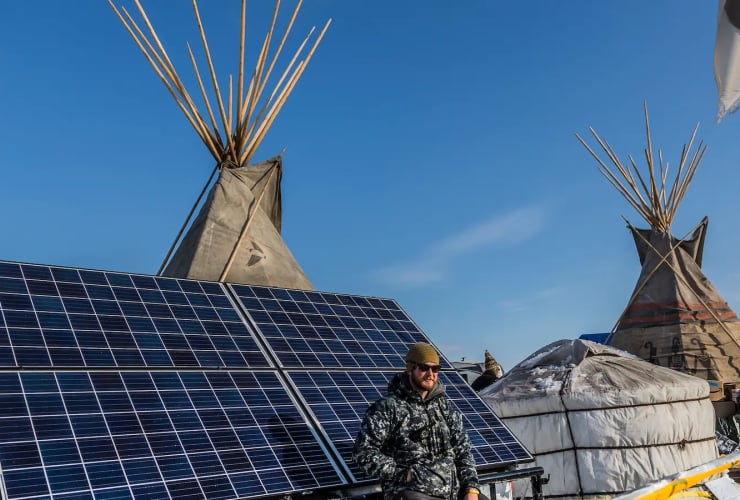
Solar photovoltaic power. In this photo, Barack Obama's grandmother, Mama Sara Obama, poses with solar installation trainees in her village in Kenya. Greenpeace and Solar Gen offered to install solar panels on her roof.

Concentrated solar power can also provide power for large communities, Greenpeace says. By concentrating the solar heat on one point with large mirrors, it heats the top of the tower to temperatures hot enough to melt steel. The heat is then used for power generation or energy storage.

Wind power at a Guazhou wind farm near Yumen in Gansu province. China has set a target for renewable energy consumption of 15 percent of the market by the year 2020. Photo from Greenpeace International.

Geothermal is a third source of renewable energy. It uses heat coming from the Earth's core, and transforms it into electricity. Iceland, pictured here, is one of the countries in the world the most advanced in geothermal. The amount of volcanoes and heat sources in the country make geothermal the most simple source of electricity. Photo from Greenpeace International.


I think it's a good idea to put photovoltaic panels on residences, but that photo of a field of them creeps me out. Where would that be? How much of our open space would have to be devoted to solar farms? Ditto with wind turbines, plus the noise and dead birds. Ocean wave energy? Does that mean big concrete installations all along our formerly pristine coasts? Geothermal seems only of use in specific localities: energy generation needs to be near the centers of energy use.
For this clean energy to replace petroleum and nuclear would require its use to increase by orders of magnitude, and that would be an environmental disaster in itself. All our deserts, mountain passes, coasts and so on would be destroyed, just as our rivers were destroyed by hydroelectric (which I notice isn't on Greenpeace's list of clean energy sources).
I don't think there's a good answer, but nuclear has a place. We've got it down to one disaster every couple of decades. A little more iteration on safety and we can get that to twice a century. It's not like Three Mile Island and Chernobyl were extinction events for mankind. Despite Greenpeace's tendentious and biased reports, the WHO says that Chernobyl has accounted for only 4,000 or so cases of thyroid cancer, a treatable cancer, brought on mostly by continuing to drink unsafe milk.
Does anybody know how much public money has been subsidizing the nuclear industry ? Lots of billion$ at least. Solar, hydro and wind power are the future. There are no risks. With Nuclear power 99.999999% is not good enough. As we're seeing all it takes is one power plant gone bad to seriously effect the surrounding area and potentially the whole planet. We just can't afford those odds even if most of them work perfectly. Solar and wind power are endless and we don't need to worry about storing spent fuel rods. If we were more energy conservative we could do just fine on alternative power sources that are all around us. Reduce, Reuse and Recycle...but the greatest of these three is REDUCE