Skip to Content

Southern Gateway: An American pipeline giant's plans for Vancouver

Starting in September 2012, Texas-based pipeline giant Kinder Morgan will begin public consultations for an estimated $4 billion expansion of its Trans Mountain pipeline from Alberta’s oil sands in Edmonton to Metro Vancouver. Their plan is to more than double the capacity of the pipeline by 2017. The project rivals Enbridge’s Northern Gateway pipeline, which aims to export oil sands crude through the Great Bear Rainforest. With the benefit of an existing right-of-way, could Kinder Morgan succeed in making Vancouver the first major artery of oil sands expansion on the West Coast? Or will their record of oil spills tar up their plans?


This is the first in a five part series, Southern Gateway: An American pipeline giant's plans for Vancouver.

Read More:
« prevnext »
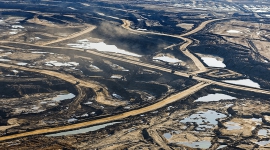
1. A view of the Alberta tar sands in Fort McMurray. Photo credit: Kris Krug (kriskrug.com) 2. The proposed Northern Gateway pipeline and the existing Kinder Morgan Trans Mountain pipeline. Graphic by Hanna Stefan (hannastefan.com)

On a hot afternoon in July 2007, a worker started digging a new sewer line for the municipality of Burnaby, following instructions crafted from a chain of wrong assumptions. Before long, he punctured a pipeline once, and then twice, unleashing an explosion of heavy oil that rose 30-metres in the air and gushed for almost 30 minutes.

Within an hour, the neighbourhood that had been saturated with rain for over a week would be coated in 224,000 litres of thick black albian heavy synthetic crude oil that had travelled down a pipeline all the way from the heart of Alberta’s oil sands.

The geyser splattered cars on the highway and spewed over rooftops and lawns. A video of the spill shows a crew worker standing a block away snapping photos, deaf to the panicked cries of a woman across the street.

“Hey! What is this?” the woman yelled repeatedly. “Should I leave my house?”

As a powerful stench of rotten eggs filled the air, those who were home and close by started leaving on their own initiative. Firefighters later walked from door to door advising residents to evacuate. The spill temporarily displaced 250 people, damaged eleven houses and rendered five unliveable for the next four months.

It was a rude reminder of the risks involved with transporting an ever increasing quantity of oil. 

The other pipeline

Vancouver has been shipping crude oil from Alberta since the 1950s, thanks to a somewhat forgotten, not-so-little pipeline that begins its pull in Edmonton. The 1,150 km Trans Mountain pipeline brings oil through prairie wheat fields and Jasper National Park, over mountains and down the sides of canyons, under river beds and into the busiest port on the West Coast of Canada.

American demand for fuel during the Korean War in the early 1950s sparked the creation of the pipeline that continues onto Bellingham, Washington. From start to finish it carves through some of the most spectacular scenery in the world. 

During construction at its steepest point, workers and tractors hung off the sides of cliffs at Coquihalla Canyon, where elevation drops 3,600 ft. in 48 km, in what was called “operation yo-yoing.”

Workers hang off a cliff at Coquihalla Canyon during construction of the Trans Mountain pipeline in 1953. Screenshot from "Oil Across the Rockies" found on YouTube.

Today, consumer demand for Alberta oil sands drives Kinder Morgan’s plans to twin the Trans Mountain Pipeline and more than double its capacity to 750,000 barrels of oil per day. That’s more oil than what Enbridge is proposing to flow through the Northern Gateway pipeline towards the coastal community of Kitimat, BC.

If Kinder Morgan, the biggest pipeline company in North Americaup to 300 tankers a year could come pick up oil from the Trans Mountain pipeline.

With the benefit of an existing right-of-way, Kinder Morgan is hoping to complete the expansion by 2017. If successful, it would equal a thirteen-fold increase in tankers since the company purchased the pipeline in 2005. 

The company states it will begin public consultations on their expansion plans in September and will apply to the National Energy Board (NEB) for approval in 2013.

According to Kinder Morgan Canada spokesperson Lexa Hobenshield, the project will cost approximately $4 billion, of which 99 per cent will be spent in Canada on goods and services. In an e-mail to the Vancouver Observer she wrote,

"This expenditure is estimated to lead to increased Gross Domestic Product (GDP) in Canada of approximately $3.5 billion, labour income of approximately $2.3 billion and approximately 37,000 person-years of employment."

Yet, according to BC's Environment Minister Terry Lake in a CBC article, Kinder Morgan needs to prove the project is in the public interest of BC before it can go ahead.

Quiet incremental expansions

Kinder Morgan’s plans for expansion were never exactly secret but their incremental approach to expansion so far has allowed them to avoid the same degree of public scrutiny as other pipeline projects such as Enbridge’s Northern Gateway or the Keystone XL. 

When Kinder Morgan bought the Trans Mountain pipeline in 2005, 225,000 barrels of oil flowed through it each day and 22 tankers traversed the inlet to pick up crude oil bound for Washington and California. 

The Trans Mountain pipeline is operated by Kinder Morgan Canada and owned by Kinder Morgan Energy Partners, both subsidiaries within Kinder Morgan's "family of companies."

Three months before the 2007 Burnaby oil spill that Kinder Morgan's subsidiary (Trans Mountain Pipeline L.P.) would later be charged and convicted for under the provincial Environmental Management Act, the company added ten new pump stations and boosted the pipeline’s capacity to 260,000 barrels per day. 

A year after the spill, before the investigation into its cause was even completed, the company finished expanding that same pipeline at a section that runs through Jasper National Park. The expansion increased the pipeline’s capacity to 300,000 barrels per day. 

Communities on the West Coast were never consulted despite being on the receiving end of the extra amount of oil.

By 2010, 71 double-hulled tankers made their way through Vancouver’s harbour to Washington, California, and China, three times as many as when Kinder Morgan first bought the pipeline in 2005. 

Buried underneath the public outrage against Enbridge’s proposed Northern Gateway, are plans as significant in magnitude for the populated metropolis of Vancouver. With the only existing pipeline connecting Alberta’s oil sands to Asian and other markets, Vancouver’s aspirations to become the greenest city on Earth are about to be put to the test.

While celebrities in the U.S. were getting arrested in front of the White House last summer at the Keystone XL pipeline protests, environmentalists in British Columbia were making pleas to keep the northern coast and Great Bear Rainforest pristine and free from Enbridge’s oil sands pipelines and tankers. 

The Kermode or white Spirit Bear is a black bear with a recessive gene native to the Great Bear Rainforest. Photo credit: Jackmont, Creative Commons

Overshadowed by the iconic images of hand-cuffed celebrities and the Great Bear Rainforest’s mysterious white Kermode or Spirit Bears are grand plans for the south coast of BC, plans that some on the coast would discover by accident.

Almost missed the boat

During the late summer months, in the waters surrounding southern Gabriola Island, a family of resident orcas feed on herring that swirl in an especially strong current. The mammals’ endangered status is just one reminder of the fragility of this marine ecosystem.

 
An endangered orca pod off the coast of British Columbia. Photo credit: S.E.Ingraham, 23 March 2012, Creative Commons.

On October 13, 2011, the federal Minister of Environment announced a tentative boundary for establishing a National Marine Conservation Area Reserve that would stretch 1,400 square km from the southern tip of Gabriola Island to Saanich Inlet, just north of Victoria. While marine biologists, conservationists and local residents celebrated, some were concerned over a proposal to increase oil tanker traffic through an ecosystem already under so much stress. 

Sheila Malcolmson has seen all kinds of vessel traffic go by Gabriola Island. She’s lived on the the island for 17 years and as the chair of the Islands Trust Council, a federation of local municipalities from the Gulf Islands, she makes it her business to watch for any increase in ships through the Georgia Strait. 

But Kinder Morgan’s application to the National Energy Board last summer was nowhere on her radar.

“We could have missed the boat so to speak completely on this one,” Malcolmson said.

Amidst a stream of Google alerts on vessel traffic through the Salish Sea, one of Malcolmson’s staff at the Islands Trust Council noticed one in particular. 

Near the end of March 2011, a news release from the NEB stated that Kinder Morgan was applying for permission to secure long-term contracts with shippers, a key to gaining the financial certainty needed to further expand its pipeline’s capacity. 

The hearings, the news release stated, would be held in Calgary that August. Those interested in participating had until April 21 to apply -- just under a month. 

Comments would be accepted in writing until June 17, the noticed continued. Malcolmson and her team spent the next three months racing to understand all they could about the application and its significance. 

As it was not advertised anywhere that would be accessible to coastal communities, she credits the “diligence of one staff person” for making her team aware of the issue at all. 

In fact, Malcolmson even doubted whether her team had rightfully interpreted this particular application as a concern.  

“If we are reading this right, this looks really significant,” she concluded later, after deciphering the application’s legalese with help from experts. 

Why are we the only people that know?

From April through to the end of May 2011, Malcomlson and her team spoke to industry personnel, environmental lawyers and federal regulators to gain a deeper understanding of the convoluted regulatory process and Kinder Morgan’s plans.

“I can’t think of anything else that has been as complex for us to analyze,” Malcolmson said.

As a local government with the capacity to focus a lot of time and energy on shipping safety, it was still a huge challenge. 

It was also difficult to find experts to hire for analysis who weren’t working for the oil and gas industry.

“That was kind of an eye opener as well,” she said, adding that she’s not questioning their ability to give independent opinions. She just found that many aren’t even available to hire to give independent opinions.

“So many are working within the oil and gas sector.”

Changing the month-to-month contracts with shippers to 15 or 20-year contracts could more easily allow the recording breaking amount of oil shipped through Vancouver in 2010 to become a new normal. 


A tanker moving through Vancouver's shallow waters. Photo credit: Bill Gannon.

She couldn’t help but feel uneasy though that her team was the only one ringing the alarm. 

“Why are we the only people that know?” Malcolmson wondered. 

She was convinced that a proposal that could potentially be so significant for the region would have surely been brought up already by at least a few other coastal communities. So convinced, that on the last day of a meeting in April that year with nearby municipalities, her team lost their nerve and chose not to bring forward a resolution addressing the issue. 

“If we’re right on this,” she thought, “we’ll find other ways to get the message out.” The last thing she wanted was to bring a resolution forward to be signed by other local governments only to have interpreted something wrong.

The risks that no one chose to take

After months of research, the Islands Trust Council, along with a handful of NGOs, made the deadline and sent a letter to the National Energy Board asking for more public consultation with coastal communities and more time to comment. 

The letter raised the concern that these long-term contracts would inhibit regulatory agencies’ ability to decrease the number of tankers in the Georgia Straight, a flexibility that exists for the sake of protecting the West Coast’s fragile marine ecosystem.

Two days later the Board responded.

It was not persuaded that the hearings should be moved to Vancouver or that the deadline should be extended, despite the impending decision’s direct impact on Vancouver, its waters and its surrounding coastal communities.

During the annual conference for the Union of BC Municipalities in September 2011, the City of Victoria and the City of Burnaby sponsored a resolution demanding that any decisions around oil tanker traffic on the south coast not be made without thorough consultation with the public, local governments and First Nations.

Instead, without any public consultation, in December 2011, the NEB approved Kinder Morgan’s application to seek long-term contracts with shippers. 

Financial drivers, not regulators mandated to protect the environment, nor local communities directly affected, made the decision about long-term tanker traffic in Vancouver. 

Hobenshield wrote in an e-mail that actual throughput to the Westridge Terminal varies and that 2010 was a record year with 83,000 barrels per day being transported by tankers from their terminal. 

This new approval by the NEB allows Kinder Morgan to seek long-term contracts with shippers for up to 54,000 barrels per day with another 25,000 barrels per day on month-to-month contracts.

“The bottom line is that the Firm Service allocation reflects throughput already being delivered to Westridge in recent years,” Hobenshield wrote.

Only now those high numbers can more easily become the new minimum rather than the record-breaking exception.

Kinder Morgan Canada declined a request for an interview. The Vancouver Observer was told that CEO Ian Anderson and other representative were not available for an interview for this series. 

Comments