Pushing Enbridge pipeline through without First Nations' consent?
Last week, some of the biggest players in the North American oil and gas markets gathered at the Four Seasons Hotel in Vancouver for the Canadian Oil and Gas Export Summit. While protesters outside the hotel yelled “No tankers, no pipelines, no tar sands,” industry insiders presented their visions for the future development of the Enbridge Northern Gateway Pipeline project, the Keystone XL pipeline, and Alberta tarsands oil.
This is the second of a special three-part series on the Summit.
Can Enbridge push through the controversial Northern Gateway pipeline in the face of heavy First Nations opposition?
For many attending the Canadian Oil and Gas Export Summit in Vancouver last week at the Four Seasons Hotel, this was the foremost question in their minds.
Two different views emerged from the talks —one from Enbridge's public outreach firm, and the other from its management ranks.
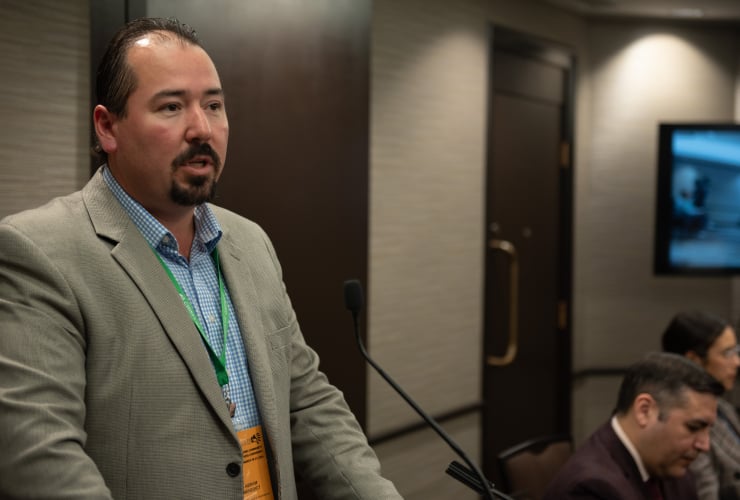
Communica Public Affairs principal Douglas Ford, whose firm does public outreach on behalf of Enbridge, gave a riveting presentation about the history of oil on BC's coast and his company’s approach to addressing Aboriginal concerns regarding oil development projects.
“If you can't bring your A-game and A-team to negotiate with First Nations over a development project, don't bother,” he said. The small audience of around 15 people listened with rapt attention as the blond, ruddy-faced Ford stressed both the vital importance and daunting challenges of gaining First Nations support for the pipeline.
One particularly attentive listener was U.S.-based Energy Policy Research Foundation president Lucian Pugliaresi, who remarked after Ford’s presentation that the woes of American pipeline proponents paled in the face of struggles faced by companies dealing with First Nations in BC.
Ford said while First Nations technically didn't have any veto on the Northern Gateway project, a “social license” with their consent would make the Northern Gateway pipeline that much more legitimate for regulators to accept.
Rather than offering easy solutions on how to gain backing for development projects, Ford spoke of grueling challenges and need for empathy with First Nations' concerns. He addressed some of the major worries of pipeline proponents who had seen 100 per cent opposition at Smithers (Ford indicated that unanimous opposition was a “litmus test” as to whether a project could be approved in BC) and the recent large-scale “Freedom Train” protest in which First Nations from across Canada went to the Enbridge AGM to voice their opposition to the project.
Note to pipeline proponents: "It's not always about you"
Ford outlined Enbridge’s strategy of early engagement with First Nations and relationship building – and the importance of finding out what they want.
“Patience and empathy are important – it's not always about you,” he told the audience. “Ask what success looks like to the First Nations and find a way to mirror that.”
He noted that despite high profile protests in the news, First Nations were a diverse group and not all unanimously opposed to projects like the Northern Gateway.
“Don't let anyone ever tell you First Nations are opposed to everything — they’re not opposed to many different projects be it hydro or renewable power,” he said.
He advised industry proponents to avoid pitfalls in speaking with First Nations by ensuring that every meeting, email and conversation was properly documented.
Enbridge engagement with First Nations will get more complicated, says Ford
Ford warned audiences that engagement with First Nations would become more complicated in the future, not less. Following the Save the Fraser declaration, First Nations have become increasingly dramatic in voicing their opposition, such as the Bella Bella student hunger strike and the Yinka Dene Alliance Freedom Train, which culminated with a mass protest and disruption of Enbridge's annual general meeting in May.
Coupled with environmental non-government organizations (ENGO)s, he said, the tactics risked becoming more confrontational in the future.
“ENGOs are most effective when they align with First Nations,” he said. This pairing is powerful because environmental groups are “often far more nimble and determined and far better at communication than government and industry” and “well-funded”. The First Nations, meanwhile, had well-defined rights over their traditional land and could use them to block the kinds of developments that environmentalists opposed.
When an audience member questioned whether a small group of First Nations could actually win a legal battle against pipeline proponents, Ford responded succinctly:
“There's a long line of dead lawyers who have fought Aboriginal rights and title.”
Whether they acknowledge it or not, he said, the First Nations were a “fourth level of government”. Proper engagement with First Nations leaders, he stressed, was in some ways even more important to the regulators than any other aspect of a project — more than engineering, more than economics. Screwing up on First Nations engagement, he said, would likely make any industry proponent the equivalent of a “project manager barista”.
The spectre of Exxon Valdez
Ford outlined the “visceral” importance of clean water to the coastal First Nations – anything that has an impact on the water, he said, has a profound effect on the First Nations. He also pointed to the spectre of the Exxon Valdez spill – a “dumb, dumb, dumb” accident – as the reason for which many Aboriginals are wary of the Northern Gateway pipeline.
"We really struggle as industry proponents with how we marry society's desires with the business drivers that underpin every project," he said. "If a project is designed by an engineer, you know there is a start date and end date. We struggle with how that can be managed to achieve social license."
Ford said the pipeline could be approved, but that there were major challenges ahead due to the current opposition of First Nations leaders.
Enbridge will go through: Paul Fisher
The last speaker of the day after Ford was Enbridge commercial's vice president, Paul Fisher. Fisher’s presentation was a marked contrast to Ford’s. Fisher emphasized the economic benefits of the pipeline to First Nations and assured that the Northern Gateway pipeline would go through because it would increase Canada's competitiveness in the global market.
At one point during his brief presentation, Fisher showed a PowerPoint slide with the words “civil disobedience will result.” It was an unsourced quote from an article about how First Nations groups would respond if Northern Gateway were approved.
In a chastising tone, Fisher smiled and remarked:
“That's not how you try and get along with people.”
While Ford stressed the importance of consultation with First Nations, Fisher presented a more nuanced picture of Aboriginal rights in the face of developer interests:
“Aboriginal treaty rights are not absolute,” he said. “Rights may be infringed upon. If infringement does occur, consultation is required. A project proponent has the obligation to mitigate infringement or provide accommodation, but that must be proportional to the scope and scale of the infringement. Accommodation can be reduced by a court.”

Fisher stressed the gains that First Nations stand to make by supporting Enbridge on the pipeline:
- $300 million in procurement opportunities
- $3 million per year community investment fund
- $300 million in marine joint ventures
- $100 million in economic activity for First Nations
- 10 per cent of project in equity to 45 First Nations
Asked how many First Nations groups had signed equity, Fisher said that 24 had signed so far (the deadline was May 31). When an audience member remarked that 24 out of 45 didn't seem like much, Fisher replied that he knew that Enbridge wouldn't get every group to sign and that two-thirds was the goal.
When a representative from Communica asked if Enbridge was disclosing which Frist Nations groups had signed the equity agreement, Fisher said no. "One First Nation (the Gitxsan) did come out of the closet last December, much against our recommendation not to, and it kind of it blew up in their face."
He noted that the pipeline had much more backing from First Nations in Alberta, and that the support "dwindled as you move toward the coast."
An ill-informed "bandwagon"?
Fisher related the story of his university student daughter, who was asked by friends if she wanted to join a protest against Enbridge Northern Gateway pipeline. He said none of her friends seemed to know why they were protesting and were simply doing it because it "seems like fun": this ignorance, he said, was the basis for many people in BC currently opposed to the Northern Gateway pipeline.
"They don't know the issues – they're just jumping on the bandwagon," he said.
He drew attention to the World Economic Forum report finding that Canada's recent drop from 9th to 12th place in global competitiveness, and argued that Northern Gateway would need to be approved to make the country more attractive for foreign investment.
Asked what would need to happen to push through an "action that is unpopular but in the best interests of the nation to open [oil] markets," Fisher suggested that the Conservative government's new omnibus Bill C-38 may help.
"Bill C-38 now gives reciprocal ability to the federal government. In the past, the NEB (National Energy Board) could recommend a project and feds in cabinet could turn it down. [With Bill C-38], if the NEB recommends not to proceed with a project, cabinet could overrule that as well.”
In other words, the National Energy Board could say no to Enbridge Northern Gateway, and the federal government could overrule this decision to approve the pipeline.

However, he spoke of the necessity of having social license from First Nations and BC communities in the building of the pipeline.
Pugliaresi, who said, as an American, he found the discussion of First Nations fascinating, noted that there may be "hidden benefits" for oil proponents in the US if Enbridge were approved.
"There may be a hidden benefit in this for the US," Pugliaresi said. "It's likely to improve our regulatory program. Keystone (XL) is a regulatory failure. The scarce resource is petroleum -- that's the resource we want to maximize the production of in terms of the health of North American economies...it's a good thing for the US as well."
Fisher agreed on the project's importance, but acknowledged the difficulty of getting it through without strong support from First Nations and Northern BC communities.
"Are we prepared to put $6 billion in a project that doesn't have the communities' support?" he asked. "That's a tough question to answer."
This story is one in a series about the Canadian Oil and Gas Export Summit. Click here for part one: Koch brothers' "ideological twin" in Vancouver to strategize with oil industry and part three: BC Premier Christy Clark not working hard enough for LNG, energy expert says