“You can’t drink the oil, you can’t eat the money”: First Nations women to the Nobel Women’s Initiative delegation
Kandi Mossett of the Indigenous Environmental Network, Nobel Peace Prize recipient Jody Williams and Chris Page of the Center for Environmental Health presented the findings of their visit to communities impacted by the oil sands and Northern Gateway Pipeline proposal at a press conference October 16.
You might recognize Jody Williams' type: the woman who always gets asked to speak at rallies because she has a gritty way of speech, a full bore commitment to her cause and a voice is big enough to reach the back of the crowd. Jody Williams won the Nobel Prize in 1997 for her work as strategist and spokesperson in the effort to ban land mines.
Jody Williams received the Nobel Peace Prize fin 1997 or her work as founding coordinator for the International Campaign to Ban Land mines which resulted in an international ban against anti-personnel land mines.
To Williams, peace is security. Not national security, but human security, where people have what they need, like clean food and water. She sees the Nobel Peace Prize platform as a tool to amplify the voices of women who are in the path of industrial projects that put these things at risk. This brought her to Canada as part of a six-woman delegation to tour communities affected by the oil sands and the Northern Gateway Pipeline proposal.
Kandi Mossett of the Mandan, Hidatsa and Arikara Nations of North Dakota, is part of that delegation and also works for the Indigenous Environmental Network. “Women are water keepers,” she said. “So they are often the first to understand what is going on.” She found that the First Nations impacted by oil sands projects had not given “free, prior and informed consent.”
Such consent is required under the UN’s Declaration on the Rights of Indigenous Peoples, to which Canada is a reluctant signatory.
“Consultation was being paid to attend a picnic,” she said, “and then being asked to pose for a picture. The result of these projects was that people couldn’t even use the water in Fort McKay for five months. Mothers couldn’t bathe their children.”
Both Mossett and Williams were heartened by the spirit of the women they spoke with. “These were warrior women with their fists in the air saying they will stop the Northern Gateway Pipeline and, ultimately, the tar sands,” Mossett said.
Williams said, “I wanted to stand up and cheer every time I heard a grandmother, sometimes next to a daughter nursing a granddaughter, stand up and say, ‘It will not happen.’ Not ‘we hope we can stop this,’ but ‘we will lay down in front of the bulldozers and we will not let them pass. These women were not joking.’ In Williams’ words, “They will drive a stake through the heart of the tar sands.”
Mossett spoke about food security impacts on traditional territories as a result of oil sands pollution.
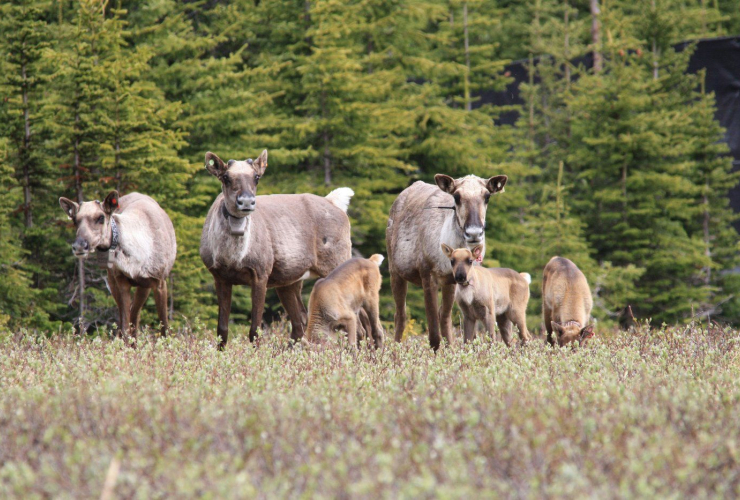
“People still heavily rely on subsistence lifestyles,” she said. “The moose have huge pustules that they are cutting off and then they aren’t sure if they should eat the meat. Ten percent of the fish pulled out of the Athabasca River have some time of tumor or cancer or double jaw.”
Climate change is impacting food supply on traditional territories as well. “The moose are supposed to be big and fat right now but they are not. They’re not healthy.” Moose are known to be affected by climate change through exposure to warm weather and parasites that die out in cold winters such as brainworms, ticks and liver flukes. Mossett also noted that plant ripening times were changing.
“Women told me that they used to pick three kinds of berries in succession and now they all come ripe at the same time.” Women also spoke of unusually low winter temperatures and low water levels.
Willliams was stunned by women’s reports that the government had called them eco-terrorists and enemies of the state for trying to protect their traditional territories. “These women are standing up to protect what the government should be protecting and then I hear from them that they have been called conspirators, eco-terrorists, enemies of the state. And I think, ‘This is Canada? This woman with a walker is an enemy of the state? All of these communities and all of these people are enemies of the state?’ I would say that the state is the enemy of the people it is supposed to protecting.”
Nor was Williams impressed by the Canada China Foreign Investment Promotion and Protection Act, a piece of legislation scheduled to take effect in November that would subject elected governments that attempt to regulate activities in which China has a financial stake to lawsuits that could proceed behind closed doors.
“If people don’t stand up and fight, there will be a secret agreement between the government of Canada and China allowing China rights to exploit the tar sands. They are not even allowing discussion in parliament about this,” Williams pointed out.
Williams said, “I keep asking myself, did you all elect this person [Prime Minister Harper] to make secrete deals with China? I find it totally freakin’ mind boggling.” No one at the press conference broke the news to her that, unlike in the U.S., Canadians don’t actually elect our head of state.
Williams also described her tour of Suncor’s oil sands operation. “The tour was given by three women of course, to show that there are women who support this great enterprise. When we asked them about the impact of the tar sands on health, they said there was none.
This was after we had listened to a woman weeping because seven members of her family had died, including her father and mother, and her children were growing up with death around them. We asked about the impact on the air. We were told that the tar sands area has better air than Toronto. And this was after we had listened to women weeping because their children could not breathe. We asked them about the river. The lovely lady said, ‘We don’t have to worry about the water. We’re grandfathered in. Only the new companies that come in have to worry about their impacts on the water.’ I thought, ‘Where is your morality? Where is your soul?’”
Two of the recommendations that the Nobel Women’s Initiative delegation will be making are:
- That people demand that the government immediately conduct surveys on the cumulative impacts of the tar sands, its possible expansion and the proposed pipelines; and
- That people fight for a moratorium on the CCFIPPA trade agreement so that there can be a full public discussion and hearings. (Leadnow.ca has a website for this purpose)
“Once we come to a place,” Williams promised, “we follow through. We’ll be back.” One of the delegates, Liz Bernstein, will be attending the Defend Our Coast protest in Victoria on October 22.


No, you don't drink oil or eat money. But oil gets sold to make money, and money gets used to pay for all those eltitlements you demand for the reserves each year. More and more every year. Presuming your "leadership" doesn't fritter it away on their cronies and overpaid band councils with equally overpaid chief/s. Never mind having a per capita representaion on the councils that is rediculous in terms of number represented. But, hey. Go ahead and glorify a stone age lifestyle while demanding money from those working in the modern era, while also getting the benefits of said modern era while spitting on people trying to keep that modern era functioning. Aint gonna feed a world of 7 billion on a subsistance lifestyle.