2010 dealt Canada and Planet Earth record-breaking hot, soggy weather
For years Canada has been heating up more rapidly than the earth as a whole. But even so, 2010 was shocking. Environment Canada says our nation smashed the record for hottest year ever: a full 3.0 C hotter than normal. The previous record was 2.5 C warmer. Only two years had ever even broken the 2.0 C warmer mark in Canada before. We have leaped into uncharted territory.
Canadian Hotspots

“We can no longer expect that things will soon return to normal, because in a world with a rapidly changing climate system there is no norm to return to.” – Lester Brown.
As the map above shows, no corner of our gigantic nation had a “cool” year. A tiny portion of the lower prairies was close to “normal”…whatever “normal” means anymore. But the vast sweep of Canada was overheating big time.
The effects were felt most strongly in our northern areas. Climate scientists have been caught off guard in recent years by the extreme pace of Arctic meltdown. The rapid, sudden melting is happening far faster than anyone predicted or thought possible. Sure enough, last year continued the near free-fall in sea ice volume:

Our Hudson Bay melted out a month early in the spring. But that turned out to seem almost “normal” compared to the unprecedented fact that now, in mid-January, the bay seems to have forgotten that it always freezes over by now. Yet somehow, nearly a third of Hudson Bay area (400,000 sq kilometres) has yet to do what it always does -- turn to ice. Temperatures are running up to 16 C warmer than usual in parts of Hudson Bay and Greenland this winter. An equally huge area of Baffin/Newfoundland sea ice just plain missing as well.

As I reported previously, climate scientists are starting to discover links between the unprecedented warmth in the Hudson Bay and Baffin Island areas and the nasty outpouring of extreme cold Arctic air into Europe, Asia and North America. The jet stream is being pushed into some very unusual shapes these days by our new climate reality.
Definitely uncharted waters.
Planet Earth: Hottest year, hottest decade
Planet Earth joined Canada in the overheating frenzy with 2010 coming in as the hottest year ever recorded, tied with 2005, according to both NASA and NOAA.
The ten hottest years ever recorded have all occurred in the last dozen years. If we continue our fossil fuel pollution much longer, we will look back on these years as “cool” and “calm”.
The decade that just ended was the hottest recorded, breaking the record held by the 1990s decade by 0.36F. Decades have been averaging .36F warmer since the 1970s. A relentless march into increasing misery. At least until we drastically cut our fossil fuel pollution that is driving this.
It has been 35 years since global temperature fell below average. The last cooler-than-normal year was 1976. Gerald Ford was US President, Montreal hosted the Summer Olympics, the Bee Gee’s “You Should be Dancing” topped the USA singles charts and the CN Tower opened. Those days, and that climate, are long gone.
An unprecedented 18 nations suffered their hottest day in history last year, an all time record in itself. That included the hottest temperature ever recorded in Asia: 53.5C in Pakistan.
Several spectacular heat waves occurred during 2010. The longest was an unprecedented two-month heat wave in Russia in which the nation broke the 100F mark for the first time ever. Records go back a thousand years. Large crop losses, tens of thousands dead and major forest fires resulted.
The Amazon suffered its second “100-year drought” in the last 5 years. These two mega-droughts are different in cause from the droughts of the past. We seem to have polluted our climate system into a new super-drying pattern for the “lungs of our planet”.
Record warm sea surface temperatures lead to widespread global die off of coral reefs. Up to 90% bleached or died in parts of the coral triangle around Indonesia. 2010 was second only to 1998 when 16% of the world’s reefs died in a single year.
Record heat in cooling cycles?
The record temperature in 2010 is particularly unsettling because the last half of the year was marked by a transition to strong La Niña conditions.
Having half the year in a strong La Nina used to cause global temperatures to be much lower than normal. That was in the old, Earth 1.0 with a stable, predictable climate upon which humans developed our civilization, cities and agriculture. Now, our ever increasing fossil fuel pollution has cooked up a new Earth 2.0. Things don’t work the same anymore.
Even more troubling is that these record smashing temperatures are happening while “the sun is in the pits of the deepest solar minimum in nearly a century.” That too should be causing the earth to cool.
Both the sun and the primary ocean temperature cycles were in their cooling phase and yet 2010 was the hottest year recorded. Both these natural cooling cycles were totally overwhelmed by our relentless dumping of billions of tonnes a year of climate-destabilizing pollution into our climate system.
“...humans, by burning fossil fuels, are now increasing atmospheric carbon dioxide by 2 ppm per year. In other words, the human climate forcing is four orders of magnitude – ten thousand times – more powerful than the natural forcing. Humans are now in control of the future climate, although I use the phrase “in control” loosely here.”
Planet Earth: Drowning in the hothouse
One of the facts that all future generations will know and fear, if we don’t quickly cut our fossil fuel pollution, is that warmer air holds more water vapour.
Water vapour is the fuel of storms. Adding water vapour to the atmosphere is like dumping gasoline on a house fire. More energy, higher winds, more rainfall and snowfall, lower pressures: weather extremes and chaos. Measurements show that the our atmosphere holds 4% more water vapour on average already.
Sure enough, 2010 set the record for the wettest year ever recorded, according to the Global Historical Climatology Network, which collects data from meterological organizations around the world.
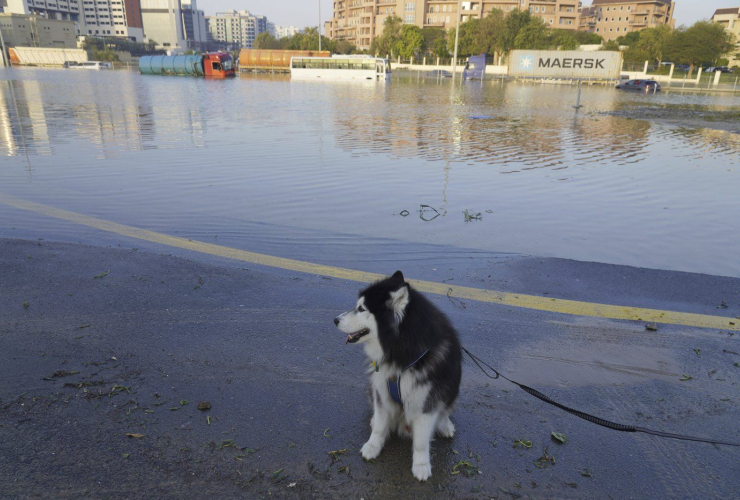
Shocked, drenched and displaced millions from Pakistan to China to Tennessee to Australia to Mexico through South America learned this climate fact through personal tragedy and devastating loss. Top meteorologist Jeff Masters termed it the “globe's parade of massive flooding disasters” just one part of the “wild weather year of 2010”.
Munich Re, one of the world’s largest reinsurers is worried:
“Munich Re’s natural catastrophe database, the most comprehensive of its kind in the world, shows a marked increase in the number of weather-related events. For instance, globally there has been a more than threefold increase in loss-related floods since 1980 and more than double the number of windstorm natural catastrophes… the only plausible explanation for the rise in weather-related catastrophes is climate change. “
The wild weather is starting to take its toll on our food supply, too. Last week the U.N. Food and Agricultural organization announced that its food price index just hit an all-time high. As Lester Brown spells out in a must read article “The Great Food Crisis of 2011” in Foreign Policy magazine, climate change is becoming the last straw heaped onto all the other growing pressures on top of our global agriculture. “These climate-related trends seem destined to take a far greater toll in the future.”
With an additional 200,000 new people to feed everyday, it is the height of stupidity to also be destabilizing the weather these crops rely on with literally billions of tonnes of climate-altering emissions every year. We don’t even have any national policies to try to rein them in. We aren’t even trying to make the connections through public policy that would allow us to strategize a more stable future…though we are most definitely failing.
As Bloomberg news reported today, the USA is the latest to announce weather related crop losses for 2010:
“There’s no room for error anymore” on farms around the world, said Dan Basse, the president of AgResouce Co., a commodity consultant in Chicago. “With any weather issues, we’re going to make new all-time highs in corn and soybeans, and to a lesser degree, wheat futures.”
We are setting ourselves up for ever more severe and every more damaging “weather issues” until we stop dumping fuel into our climate system.
2011 New Years Resolutions
All this is unfolding with less than one degree of global warming. Imagine what it will be like in a few decades if we keep burning fossil fuels as we are now and temperatures rise 5 to 10 times as much.
What can we do?
Climate science is very clear: the majority of the fossil fuel reserves we know about must stay in the ground forever. Coal must stay in the ground. Unconventional fuels like tar sands must stay in the ground. If we burn them we will push the climate further into a chaotic, unpredictable and dangerous state that will tax civilization itself.
The goal, as Bill Gates recently said, must be to move our lives and economy rapidly to one that has ZERO greenhouse gas emission.

Fortunately the solutions are known, affordable and still doable.

At the individual level we all need to reduce our fossil fuel burning. This can be done by efficiency, conservation and switching to climate safer energy sources like BC Hydro electricity. Two areas for many people to make meaningful gains are in changing their transportation choices and using climate safer BC Hydro to heat their homes and businesses.
At the political level we must force our political system to increase the penalties for dumping climate-destabilizing pollution…and use the revenues from this to help individuals and society transition to cleaner alternatives.
Whatever the tools and actions we choose, the result has to be a rapid reduction in the amount of fossil fuel pollution unleashed into our climate each and every year until we get to zero in a few decades.
The chaotic climate changes and dwindling supply of cheap fossil fuels will ensure that humanity stops using fossil fuels soon enough. The only question we face today is whether we will leave ourselves a viable future by phasing them out now, while we still have a climate we can live with.


As the climate heats up over 5 million Canadians that presently travel to Florida, Arizona, California, Hawaii and Mexico, etc., will not have to. They will be able to stay home and bronze themselves. The saving in GHG emissions from the gigantic lessening of air travel will be beyond contemplation! Home heating usage and costs will precipitously crash since it will not be needed. The lack of enegy use will probably save the planet.
It's all good - especially to be nice and warm.