City of Vancouver celebrates Earth Day with launch of residential food scraps collection
Vancouver Mayor Gregor Robertson proudly announced a new citywide program to reduce garbage today, one that keeps table scraps out of landfills and sends them back to the soil. Standing in front of the vegetable garden in the backyard of City Hall, Robertson was ebullient as he announced "an auspicious" moment: the launch of a program that would not only transform a significant percentage of what people throw away in Vancouver into a nutrient-rich material that goes back to the soil, but an achievement that added depth to his reputation as Vancouver's "green mayor."

"It's an auspicious occasion," he said.
"I can't think of a better way to celebrate Earth Day than by launching a program that will make a huge difference in reducing Vancouver's environmental impact. The program is coming to all homes that have their yard trimmings picked up and that's over 110,000 homes.
"This was one of the 44 quick-start actions recommended by the Greenest City Action Team last year and we're now seeing it taking action. Creating a compost pick up program was the number one requested program from more than 1,000 people who gave input to the Greenest City Action Team. The goal is to reduce our waste by 40 percent by the year 2020. It's a realistic goal when you think that we create more waste per capita than the average Canadian municipality," Robertson said.
Media assembled at 9:30 Tuesday morning, the day before Earth Day, to hear Mayor Robertson's speech, announcing new citywide curbside food scrap pick up program

City of Vancouver's composting motto: "Your food isn't garbage. Turn your food scraps into compost."
"Curbside composting will have one of the most lasting positive impacts on quality of life on the city," Councillor Andrea Reimer told the Vancouver Observer. "This is all about reducing garbage going into the landfill.
"How do we take things that had a value to us and make sure they continue to have value, rather than become trash? This is about not having to put money into costly solutions like incineration. About 35 percent of residential garbage is compostable. Three phases. We start today with phase one, doing raw fruit and vegetables, tea bags and coffee grounds, which can be used.

"As of January 1, 2011, we'll move to all foods...anything that's compostable. Including pizza boxes and food wrappers that have grease on them that you can't currently put into compost and we'll put that into our industrial facility. The next phase is: we're figuring out how to work with the private garbage pick up people that service businesses and apartment buildings, condos."
What can people do to help make the program work?
"Call 3-1-1. We will need a virtual army of volunteers out on the street. Some people are very familiar with composting and we need their help, [even if] it's [just] handing out a brochure to a neighbour at their door. We have many languages in the city, many age groups, many people with different experiences. [We'd like] to get people with a lot of experience with composting to talk with people who don't have experience with composting..."
The program, Reimer said, is costing $230,000 into communications effort into this year and another $230,000 into phase II. The food will no longer go to the landfill, so it won't be traveling as far. The food will go to a private company in Richmond so no increased cost to taxpayers. In Richmond, it will be recycled into compost that will be sold to agricultural operations.
In phase II and phase III, the city will actually make money from the recycled material.
Councillor Andrea Reimer said the city needs an army of volunteers to help educate the public.

Sadhu Johnston, Deputy City Manager, (formerly---in the words of the Huffington Post---"Chicago's top Green official," )introduced Robertson, calling him, "...our green Mayor, who is pushing us to be greener every day and is leading by example." Johnston is pictured here with City Manager Penny Ballem.


Engaging Communities in Composting
"This is what a week's garbage looks like in my household. This is what you're left with when you take out the food and you clean your plates and you recycle your newspaper and your yellow bag stuff. This is what you're left with," Zero Waste Vancouver's Helen Spiegelman said (see photo below), in a speech that followed Robertson's.

"I'm speaking on behalf of the community," Spiegelman said. "I've been a community activist with an interest in waste issues for a lot of years and this is one of the happiest days of my life. We're going to deliver the program for the city."
"The context for all of this is visible in this freaky weather. The big overarching problem on the planet is the climate. This is the quickest, easiest, funnest way to deal with climate change. We're talking about every scrap in our food we put in our garbage puts a little bit of evil smelling, potent gas into the atmosphere. Every scrap we put into composting slows down climate change a little bit. This is why we see this as the quickest way to reduce waste and slow climate change."
Educating Children about Sustainability
Johnston then introduced Kevin Millsip, Vancouver School Board (VSB) Sustainability Coordinator, saying, "...this all starts at school, with our kids."
"It's incumbent upon us to put the systems in place to enable people to do what they want to do to be environmental champions," Millsip said. "At schools there's incredible interest in making connections between what we grow and what we eat, in making gardens and (in thinking about) the impact of that on the planet. One of the things we're talking about at the VSB is re-framing how we think about waste.
"As we tackle climate change, we have to get rid of the concept that there's an 'away.' Whatever I throw away goes into someone else's backyard. We have to re-educate ourselves that we can't operate that way anymore. There's a lot of pressure coming from students to do something about sustainability."
Millsip pointed to VSB's current programs as examples of what can be done to bridge environmental efforts at home and at school: a districtwide sustainability program, three composters in schools and gardens.
"This reinforces the message that what we can do at home, we can do at school and there isn't a separation between how we think of the environment. That it's part of a continuum. This is an amazing opportunity to shift our thinking in terms of what's possible around sustainability. To think about how we take our environmental challenges and re-frame them as opportunities," Millsip said.
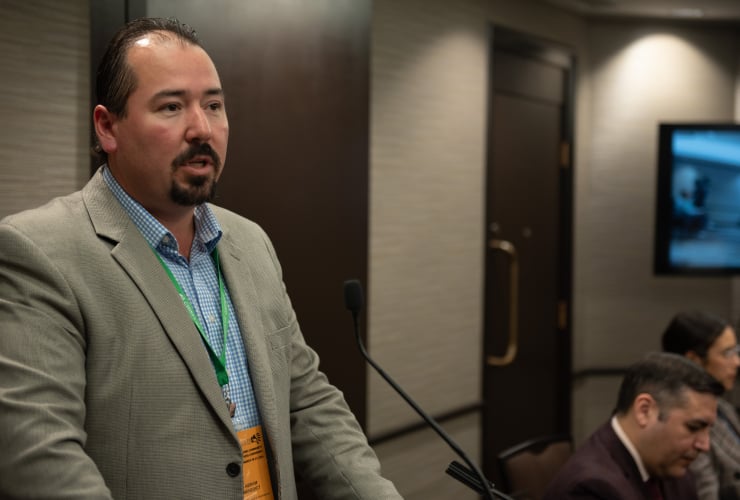
Kevin Millsip, VSB Sustainability Coordinator

Andrea Carlson, executive chef, Bishops Restaurant, spoke about the significance of the program...

Then, along with Robertson...

...she gave a demonstration of what food waste belonged to this phase of the program.
Only these food items will be collected for now. You may put in with your yard trimmings cart:
- uncooked fruit and vegetable scraps
- coffee grounds and filters
- teabags
- eggshells

A second phase of food scraps collection will be introduced in 2011 where all food scraps (fruits, vegetables, meat, fish, dairy, bread, cereal products and food-soiled paper) will be allowed.
Carlson and the mayor carried examples of the phase one food scraps to a bin...

...and dumped them out...

It may have been the most photographed waste dump in Vancouver history.

And, as city officials lauded the new composting program, a sign announced the presence of the vegetable garden that was established last year.
More from Mayor Robertson's speech:
"Almost 35 percent of garbage from single family residents can be made up of food scraps," Robertson said. "There's a clear environmental win that can happen at a household level. This is a really clear way that people in their homes and in their daily lives can make a difference in the green agenda. Also, the city saves money with this program. We divert garbage from our landfill and are able to use that for our soil. Our taxpayers benefit because we get an extra service here, without additional utility fees. Backyard composting is the number one choice in terms of energy use and the city is amping up support for that backyard composting program. Some people will prefer to put their waste in the bin that is now for yard trimmings. Starting tomorrow is just the beginning of this program..."
City of Vancouver website contains extensive information about how to participate and what to do. And here's how to get started.